
Acupuncture
Curious about acupuncture but not quite sure what to expect? You’re in the right place. Whether you’re dealing with nagging back pain, stubborn headaches, stress that won’t let go, or you simply want to feel more like yourself again, acupuncture is one of the most studied, gentlest tools we have for helping the body heal. This page answers the questions most first-timers have — in plain language — and shows you what the research actually says.
New to acupuncture? Here’s the short version.
Hair-thin needles are placed at specific points on your body to calm your nervous system, ease pain, and prompt your body’s own healing response. Most people feel little to nothing during treatment — and many feel deeply relaxed by the end. It’s safe, drug-free, and backed by large clinical trials.
What is acupuncture?
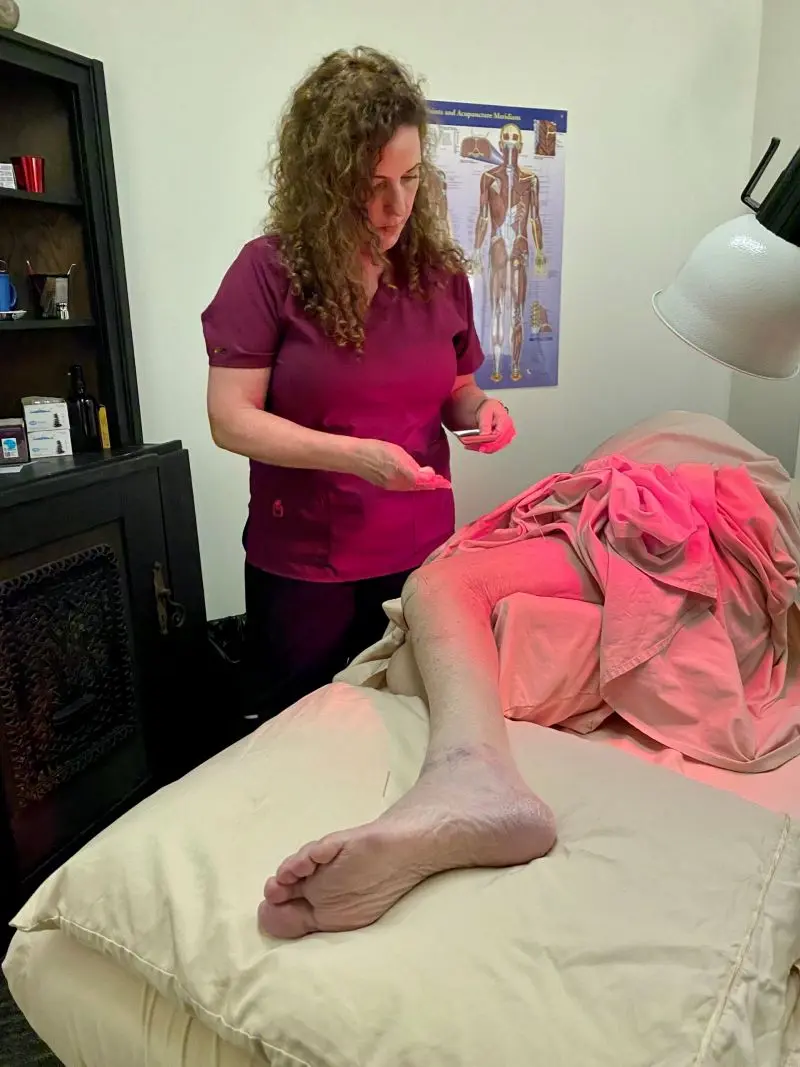
Acupuncture is a centuries-old practice in which a trained practitioner inserts very thin, sterile, single-use needles into specific points on the body. The needles are about the width of a human hair — nothing like the needles used for shots or blood draws — so insertion is usually painless or close to it.
In Traditional Chinese Medicine, these points sit along channels that carry your life energy, or Qi (pronounced “chee”). When Qi flows freely, you feel well; when it gets “stuck,” you feel pain, tension, or fatigue. Acupuncture is the art of helping that flow return to balance.
Here’s what that looks like through a modern medical lens: placing needles at these points stimulates nerves, muscles, and connective tissue. That signals your brain and spinal cord to release natural painkillers (like endorphins), calm the “fight-or-flight” stress response, improve blood flow, and turn down inflammation. In other words, acupuncture gives your body a nudge to do what it’s already designed to do — heal and self-regulate.
Does acupuncture actually work? What the research says
You don’t have to take our word for it. Acupuncture is one of the most heavily researched complementary therapies in the world, and several large, high-quality studies — including trials published in JAMA Internal Medicine — have examined whether it helps. Here’s a plain-English summary of what they found.
Chronic pain (back, neck, joints, and headaches)
The landmark study on this is an individual-patient analysis of nearly 18,000 patients across 29 high-quality trials, published in JAMA Internal Medicine. Researchers found that acupuncture was genuinely more effective than both no treatment and “fake” (sham) acupuncture for chronic back and neck pain, osteoarthritis, and chronic headaches — meaning the benefit isn’t just a placebo. (Vickers et al., read the study)
Stress and anxiety
A 2021 systematic review and meta-analysis of randomized trials in Annals of General Psychiatry concluded that acupuncture can meaningfully reduce anxiety symptoms compared with control treatments. The authors note more research is always welcome, but the signal is encouraging — and consistent with what patients report feeling. (Read the review (PubMed Central))
Migraines and chronic headaches
A randomized clinical trial in JAMA Internal Medicine followed migraine patients over time and found that true acupuncture reduced how often migraines struck compared with sham treatment and with no treatment — and the benefit lasted for months after the sessions ended. (Zhao et al., read the study)
Low back pain
In a large randomized trial of 638 adults with chronic low back pain, people who received acupuncture had greater improvement in function than those who received usual care alone. (Cherkin et al., read the study)
The honest takeaway: the science shows acupuncture’s benefits for pain are real and clinically meaningful, even if they’re described as modest. It’s not magic — it’s a safe, well-tolerated therapy that helps a great many people feel and function better, often without the side effects of medication.
Meet your acupuncturist, Dr. Dani Brunner
Your care at Attunement Wellness is led by Dr. Dani Brunner, DACM, LAc — a Doctor of Acupuncture and Chinese Medicine, licensed by the Oregon Medical Board and nationally board-certified by the NCCAOM as a Diplomate of Oriental Medicine.
She earned her Master’s in Acupuncture and Oriental Medicine from the Oregon College of Oriental Medicine and her Doctorate from Pacific College of Health Sciences. To deepen her skill with pain and sports injuries, she completed an intensive orthopedic acupuncture apprenticeship with renowned mentors including Whitfield Reaves, OMD, LAc, and Jenny Neiters, LAc (team acupuncturist for the San Francisco 49ers). That training shapes the clinic’s precise, results-focused approach to care.
Above all, patients describe Dr. Dani as someone who genuinely listens — taking the time to understand the whole picture before ever picking up a needle.

Your most common questions, answered
Does it hurt?
Most people feel little to nothing when the needles go in — sometimes a tiny pinch or a dull, heavy sensation that fades quickly. Acupuncture needles are about the width of a hair, and many are thinner than a strand of your own.
Is it safe?
Yes. Needles are sterile, single-use, and disposed of after every treatment. When performed by a licensed acupuncturist, acupuncture has an excellent safety record.
How many sessions will I need?
It depends on what you’re working with. Some people feel relief after one or two visits; others with longer-standing issues do best with a short series of weekly sessions. Dr. Dani will give you an honest, individualized estimate.
How should I prepare?
Eat something beforehand (don’t come on an empty stomach), wear loose, comfortable clothing, and give yourself permission to relax. That’s it.
Will I be able to drive home?
Almost always, yes. You may feel pleasantly relaxed, but most people return to their day right afterward.
What patients say
Real reviews from verified patients on Google.
EXCELLENT Based on 51 reviews
 Posted on Google
 Maria GuminaI've had such a great experience here! Patrick is a wonderful masseuse and he is very conscientious and careful to make sure you are comfortable and that he is using the right pressure. Great customer service as well from the whole team. Recommended!Posted on Google
 Jillian MoskowitzDr Dani at Attunement is excellent. She helped me when my back was in spasm and I could barely move, it made a huge difference.Posted on Google
 Kathy MaoDR Dani is a very good acupuncturist. She cares about her patients and listens well to them. I feel great after her treatment. I highly recommend her.Posted on Google
 David SimmonsI have been getting massage regularly for years with several very good massage therapists. A few months ago I started using Patrick, and he is absolutely the best! Very professional, very thorough, and has technics that work out every kink while putting you in a very relaxed state!Posted on Google
 Andrea AngellWent in for neck pain and pain resolved within 24 hours. I’ll continue to see Dr Dani.Posted on Google
 Joseph VossI have been a patient of Dr. Danielle Brunner at Attunement Wellness for several weeks. I was about to give up on finding anyone who could provide relief for an extremely painful neck and shoulder. Dr. Brunner spent a great deal of time with me to explore a treatment plan and care regimen. Through electroacupuncture and cupping therapy she has been able to release extremely tight muscles knots and skeletal posture and is providing much needed and appreciated relief. Dr, Brunner takes a wholistic approach to health and wellness and she has helped me immeasurable through her therapeutic practice.,Posted on Google
 Christina HernandezI have seen many practitioners at Attunement Wellness over the past 5 years and have been so grateful for the care I've received there when learning to manage my chronic pain. My original reason for going in was low back pain but Dr. Dani has helped me understand so much more the issues my body experiences including hormones, gastrointestinal issues, acute injuries, sleep quality, and overall emotional health. All of the providers I've seen here have taken phenomenal care of me, but Dr. Dani, the owner and founder is so knowledgable, kind, communicative, and caring. 10/10 recommend
Ready to feel better? Let’s get started.
You don’t have to keep living with pain, stress, or that run-down feeling. Acupuncture offers a safe, natural, evidence-based path back to balance — and the first step is simply a conversation. Dr. Dani will listen, answer every question, and help you decide whether acupuncture is right for you.
Relieve pain. Restore balance. Schedule your visit.
Book your appointment online or call 503-206-0300
References
Vickers AJ, et al. “Acupuncture for Chronic Pain: Individual Patient Data Meta-analysis.” Archives of Internal Medicine / JAMA Internal Medicine. pubmed.ncbi.nlm.nih.gov/22965186
Zhao L, et al. “The Long-term Effect of Acupuncture for Migraine Prophylaxis: A Randomized Clinical Trial.” JAMA Internal Medicine, 2017. jamanetwork.com
Cherkin DC, et al. “A Randomized Trial Comparing Acupuncture, Simulated Acupuncture, and Usual Care for Chronic Low Back Pain.” Archives of Internal Medicine, 2009. pubmed.ncbi.nlm.nih.gov/19433697
Yang XY, et al. “Effectiveness of acupuncture on anxiety disorder: a systematic review and meta-analysis of randomised controlled trials.” Annals of General Psychiatry, 2021. pmc.ncbi.nlm.nih.gov/articles/PMC7847562